Competitor Price Monitoring: Browser Pipeline Design
Competitor price monitoring needs matching offers, market context and honest observation times. Separate scheduling, browser acquisition, validation and publication.
BotBrowser Team
Want the structured docs for Deployment?
This article lives in the editorial library. For step-by-step setup, reference material, and ongoing updates, jump into the docs section.
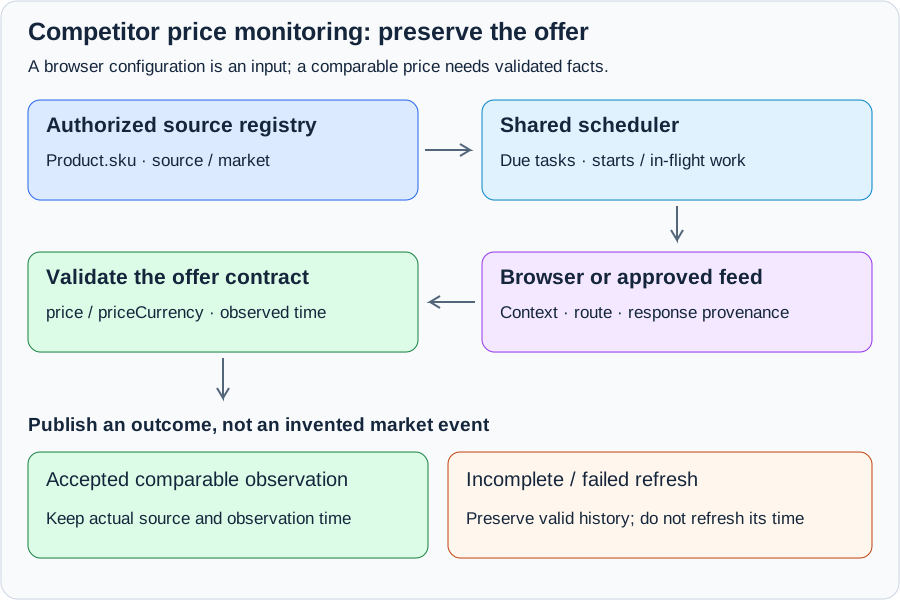
Competitor price monitoring compares observed offers, not just numbers extracted from pages. A different seller, product variant or market can produce a legitimate price difference that a collector incorrectly reports as a discount. BotBrowser supplies profile-backed browser configuration and context-level routing controls, but it does not supply product data, establish cross-merchant product identity or guarantee access to a listing. An authorized collection pipeline needs a source registry, a shared workload budget, a versioned observation contract and publication rules that preserve the difference between a new price and a failed observation.
For an Amazon-specific source decision, Amazon product data and browser limits distinguishes the current Creators API from retired PA-API and maps offer fields to actual source evidence rather than browser settings.
For Shopify source selection, Storefront API, Ajax and browser evidence separates tokenless scope, hosted-theme JSON, variant coverage and presentment currency before a product observation is accepted.
For posting-level interpretation, Indeed and LinkedIn field, pagination and duplicate rules adds a source-scoped field contract and a constructed page-overlap example that separates missing list entries from closure evidence.
TL;DR
- Compare the same product variant and offer conditions; a merchant-specific SKU is not a universal product identifier.
- Separate the scheduler, acquisition worker, record validation and publication decision so an HTML challenge cannot become an empty price list.
- Bind a browser context to a declared authorized source and market, without treating the context or its proxy as proof of identity or permission.
- Store observation time, currency, price basis and collection outcome alongside the amount. A missing field is not a zero price.
- Prefer an operator-approved feed or API when one is available and suitable; changing the transport does not remove the need for a data contract.
Contents
- Four components and their handoff contracts
- Schedule for freshness within a shared budget
- Partition browser state by source and market
- Define a versioned offer observation
- Route four failure classes before publication
- Choose the approved data-access route
- Practical conclusion
Four components and their handoff contracts
The source registry identifies what the job is permitted to collect and what the downstream application needs to compare. Keep the approved source, market, product-selection rule and access method together. An address alone does not define a comparable offer: a page can present different variants or sellers after navigation. The registry must also name the application's response contract, so a successful navigation is not confused with a usable observation. The Google Maps data-source comparison adds provider-specific field and retention limits: a place-ID exception does not authorize retaining all associated content. The real-estate listing model separates source listing occurrences from physical properties and compares asking prices only when currency and transaction meaning match; a missing card does not establish a sale.
The distinction between a product and an offer already exists in the schema.org Product reference. Its offers property describes an offer to provide an item, and sku is explicitly merchant-specific. A collector cannot join two merchants' records merely because their SKU text matches. Product matching belongs to a declared matching rule with its own evidence, separate from fetching an offer or parsing its amount. Travel adds a case where one product spans several currencies and point-of-sale rules at once: the fare capture model keeps those inputs fixed per capture so a delta stays comparable.
| Component | Input contract | Output contract | Boundary |
|---|---|---|---|
| Source registry | Approved source, market, product scope and access method | A bounded collection task | A URL is not cross-merchant product identity |
| Shared scheduler | Due tasks and the agreed workload budget | Accounted request starts and active work | A worker count is not a complete request count |
| Acquisition worker | Task, declared browser or feed configuration and allowed destinations | Response observations with provenance | HTTP success is not an application-data result |
| Validation and publication | Candidate record and the current field contract | Accepted observation or a classified failure | Missing data must not become an invented price |
Keep each handoff inspectable without copying an entire browsing session into the record. The scheduler needs a task identifier and an outcome; the price consumer needs the validated offer context and its observation time. Neither needs proxy credentials or a reusable authentication capture. Store only information that the authorized application requires, with appropriate access controls for any retained diagnostic fragments.
The ecommerce browser-layer discussion distinguishes browser presentation from the commercial facts a page serves. A pipeline should preserve that distinction after acquisition. Selecting a declared browser configuration can make a run's inputs easier to account for, but it cannot tell the consumer whether a displayed offer includes shipping, belongs to the intended variant or remains available for purchase. Those are separate record-validation questions.
Schedule for freshness within a shared budget
Scheduling begins with the application's permitted freshness objective, not a universal interval that supposedly avoids challenges. A fast-moving permitted source and a rarely changing catalogue can have different revisit needs. Treat any tier as an application choice constrained by the agreed workload and source policy. Do not invent an observation frequency and describe it as a vendor-safe allowance merely because a previous run returned data.
For each scheduled item, retain its due time and last accepted observation time as separate application fields, such as dueAt and observedAt, alongside the reason it is due. These are proposed collector fields, not a site's reported output. A retry is different from a planned revisit: both consume work, but a retry is attempting to resolve an existing failed observation. Count it explicitly rather than letting a failure loop create an unbounded second schedule. If the budget cannot satisfy all due tasks, record which tasks were deferred instead of pretending that old observations were refreshed.
The rate and concurrency reference separates request-start rate from requests in flight. Apply that distinction across the whole authorized source workload. Several workers visiting the same source share the application's budget even if their browser contexts or routes differ. Redirects, dependent assets and bounded retries can make page count diverge from network work; retain the accounting scope rather than claiming a local navigation counter reproduces an operator's rule.
Freshness belongs to a record, not to the successful completion time of the surrounding batch. A batch may finish after one source failed while other sources supplied valid updates. Keep the old record's original observation time and mark the attempted refresh separately. A dashboard that labels every retained price with the latest batch time converts a partial collection failure into a false claim about current market conditions.
The Robots Exclusion Protocol states that its rules are not a form of access authorization. Respect applicable crawler instructions while separately establishing permission and the agreed collection method. A path that is not disallowed does not grant account access or an unlimited request budget. Likewise, using a different browser context does not create another allowance when the authorized workload is already exhausted.
Price-change triggers need the same distinction between evidence and scheduling. A prior accepted observation may justify placing a product into a permitted revisit tier, but it cannot establish that the next response contains comparable conditions. Make the comparison only after validation. If a new observation changes the seller or currency, route it to the relevant matching decision rather than raising a simple numerical price-drop alert.
Partition browser state by source and market
A declared source partition records which browser state and market assumptions belong to a task. It should not impersonate a person or claim to establish an external identity. A competitor-specific label is useful only if the task and its actual request context can be mapped to it. Keep account authorization, product matching and browser configuration as separate concepts even when the application stores their references in one task record.
BotBrowser's profile configuration reference defines configuration priority and the boundary of configurable packages. Profile package authoring requires ENT Tier1; public legacy .enc files are read-only. CLI flags have priority over profile configuration and defaults. Use the documented file-based input and an absolute --bot-profile path. A profile reference records intended browser configuration; it is not a merchant account or proof that the full profile was successfully loaded.
Market context should describe the scope of the observed offer. Record the market requested by the application separately from market information actually visible in the offer. A configured locale or route does not prove that a seller selected the requested currency, tax treatment or inventory region. If the application cannot establish a required market condition from the authorized response, the record remains incomplete for that comparison.
BotBrowser's dynamic proxy switching reference describes changes for an existing BrowserContext and requires ENT Tier3, a valid loaded profile and a browser-level session. The documented update applies to subsequent requests; requests already in flight complete on the previous proxy. Await the command and serialize updates for the same context before starting work that depends on the new route. This lifecycle distinction matters when attributing an offer response to a market configuration.
Avoid using a global label such as the current market to annotate every response arriving afterward. A response may belong to a request that started before the change. Associate task, context and the relevant configuration interval at request time where instrumentation supports it, and leave unavailable attribution unknown. The arrival order of responses does not establish which network state sent each request.
Configuration changes must also preserve the task's authorization boundary. A challenge, an expired account session or an out-of-scope redirect does not become a new collection opportunity after a route update. Stop dependent extraction and use the approved recovery or access channel. Browser configuration can be inspected and corrected on an owned fixture without claiming that this establishes permission to resume a protected site's collection.
Define a versioned offer observation
A collector-owned schema version identifies how the application interprets its own records. It does not claim to identify the site's internal schema version. Change the contract when interpretation changes, and preserve enough provenance to distinguish records parsed under different rules. A new parser that changes the meaning of a price field should not silently rewrite older observations as if the same rule produced them.
| Record group | Required meaning | Validation question |
|---|---|---|
| Source and product | Approved source plus the application's matching evidence for the selected variant | Is this the product and variant the comparison intends? |
| Offer context | Seller and relevant market or customer conditions visible to the authorized job | Did the same offer conditions apply? |
| Amount and currency | The observed monetary amount with an explicit currency | Are both present and interpretable together? |
| Price basis | Known treatment of quantity, membership, shipping, taxes or other applicable conditions | Is this amount comparable under the application's rule? |
| Observation provenance | Time of the actual observation and the permitted source reference | Does the timestamp describe this response rather than a later batch? |
| Outcome and schema | Accepted, incomplete or failed observation under the collector's contract version | Should this record reach a price comparison at all? |
The distinction around sku in the Product reference is especially important for joining observations. Preserve merchant identity with merchant-specific identifiers and use the application's approved matching evidence across sources. A product family label is not automatically a variant. The same displayed title can describe different pack sizes or options, so a numerical change should not be interpreted before the relevant variant is established.
The schema.org Offer reference distinguishes price, priceCurrency and conditions such as eligibleQuantity. Keep currency attached to the amount throughout validation and storage. A bare decimal does not state whether it is comparable with another offer. Do not discard conditions simply because the price element is easy to parse. A quantity-specific or membership-dependent amount needs its applicable condition represented, or the observation cannot support a comparison that assumes an ordinary single-item purchase.
Resolve source links with the URL constructor documented by MDN, using the actual page URL as the base for a relative reference. Resolution is not string concatenation, and invalid inputs can throw an exception. After resolution, enforce the approved destination scope before any follow-up request. A syntactically valid URL neither proves that the linked product matches nor grants permission to visit its destination.
Unknown and unavailable values need explicit outcomes. A missing amount is not a zero amount; an unavailable page is not proof of unavailable inventory. A field that cannot be established from the authorized response should leave the observation incomplete under the contract. Keep this outcome out of the numerical comparison instead of substituting a convenient default that will later appear as a real market event.
Route four failure classes before publication
The layered scraper diagnosis separates transport, HTTP and page execution. A price pipeline needs that distinction before it decides what to publish. A browser can reach an HTTP response but fail the application's data contract; a parser can extract a number while selecting the wrong offer. Each failure class needs a different owner and a different outcome, rather than one generic retry loop.
| Failure class | Observable boundary | Publication action |
|---|---|---|
| Transport or access | No response, authorization refusal, classified challenge or prohibited destination | Stop dependent extraction and retain the bounded incident outcome |
| Page readiness | The authorized application has not reached its declared data-ready condition | Mark the observation incomplete when the task's finite wait policy ends |
| Record interpretation | Variant, currency, amount or relevant condition cannot satisfy the field contract | Mark incomplete and exclude the candidate from price-change comparison |
| Publication integrity | Valid records are partial, duplicated or mixed with stale data incorrectly | Preserve accepted provenance and publish only the application's explicit completion state |
Readiness should refer to the application condition the job actually needs. A navigation event does not prove that the selected offer finished loading, and an unrelated network request can outlive usable application data. Keep the wait policy bounded and name the condition that failed. An expired wait is an observation failure, not evidence that the merchant removed the product or changed its public schema.
When a response changes from data into a challenge, mid-run CAPTCHA diagnosis reconstructs the last usable and first challenged requests without guessing a hidden cause. Preserve minimal redacted evidence and stop downstream parsing. A JSON exception after an HTML challenge should not cause an empty price table to overwrite previously accepted offers.
Accepted observations and batch completion are separate outputs. Some valid records may survive a partial failure, but the application must state which source and interval each covers. Do not promote partial completion into a claim that the entire competitor catalogue was refreshed. Likewise, a stale retained observation can remain useful when explicitly labeled with its real time; it becomes misleading when a failed refresh gives it a new timestamp.
Keep deduplication separate from product matching. A repeated delivery of the same observation should not create an extra price-change event. Conversely, two legitimate seller offers should not collapse merely because they share a product reference. Define the observation identity and comparison scope before publication so recovery from a failed task does not turn transport retries into invented market activity.
Choose the approved data-access route
Prefer an operator-approved feed or API when it provides the required fields and scope. This is a source-selection rule, not a claim that every merchant exposes a suitable endpoint. Obtain the actual contract from the authorized operator. A feed can make field interpretation more explicit, but it still needs currency, offer conditions, observation provenance and an application decision for missing or delayed records.
The browser path is appropriate only when the agreed access method requires page observation and the necessary facts can be established within that scope. Product and offer semantics remain relevant regardless of transport: an acquisition method does not turn a product into a comparable offer. Keep the same downstream contract for equivalent observations while recording differences in source provenance instead of hiding them.
Do not extend a page-collection permission to an undocumented internal endpoint simply because a browser displayed its address. Nor does a feed agreement automatically authorize browser collection under different accounts or markets. Source method and authorization belong in the registry. If the needed data cannot be obtained through the approved route, return a source limitation rather than silently changing the collection method.
The robots protocol's authorization boundary also applies when selecting this route. Crawler instructions and access permission answer different questions. Preserve both in the source decision, and stop at an access refusal. A pipeline with an explicit unavailable outcome is more useful to a price consumer than one that manufactures a current observation after the permitted source stopped supplying it.
FAQ
Can equal SKU strings identify the same product across competitors?
Not by themselves. Schema.org describes SKU as merchant-specific. Cross-source matching needs its own applicable evidence, including the intended variant and offer scope.
Does a proxy configured for a market prove that market's price?
No. Configuration describes intended routing. The authorized response must establish the relevant market and offer conditions, and in-flight requests can belong to an earlier route.
Should a failed refresh delete the last valid price?
Not merely because acquisition failed. Preserve the previous accepted observation with its real timestamp and record the failed attempt separately under the application's retention and publication rules.
Does an allowed robots path authorize collection?
No. RFC 9309 explicitly separates robots rules from access authorization. Use the agreed source method and workload scope in addition to respecting crawler instructions.
Sources
- Schema.org: Product
- Schema.org: Offer
- MDN: URL constructor
- BotBrowser: Profile configuration
- BotBrowser: Dynamic proxy switching
- RFC 9309: Robots Exclusion Protocol
Practical conclusion
Build competitor price monitoring around comparable offer observations. Bind each task to an approved source and market, account for shared work, validate the product variant and price conditions, and publish the real observation time. BotBrowser configuration supplies browser inputs; it does not supply commercial facts or access permission. When a source fails, preserve valid history and expose the failed or incomplete outcome instead of inventing a price change.
This article is part of the guide: Browser Deployment and Release: Operations Map
Related Articles
How to Scrape Amazon: Product Data and Browser Limits
DeploymentScraping Shopify: Storefront API, Ajax or Browser?
DeploymentFingerprint Protection for E-Commerce Price Monitoring
DeploymentZillow Scraping: Listing IDs, Prices and Status History
DeploymentJob Posting Scraping: Titles, Reposts and Closure
NetworkEcommerce Price Monitoring: The Browser Layer
Run the same check in BotBrowser
Load a profile, keep the signals you just read about consistent inside the browser, and confirm the result on your own machine before a rollout.