Google Maps Scraping: Places API or Rendered Listings?
Compare Places API fields, rendered listings and place panels. Keep field masks, place IDs, attribution and storage limits separate from browser configuration.
BotBrowser Team
Want the structured docs for Deployment?
This article lives in the editorial library. For step-by-step setup, reference material, and ongoing updates, jump into the docs section.
Google Maps scraping starts with a source choice, not a selector. The documented Places API, a rendered result list and a selected place panel answer different questions about a location. A field returned by an API is not the same observation as text visible in an interface, and neither source grants unrestricted reuse. BotBrowser provides a configured browser context for an authorized rendered observation; it does not supply place data, remove API billing or change Google's content policies. Choose the permitted source for the required field, then preserve what that source actually establishes.
TL;DR
- Prefer the documented Places API when its supported fields and applicable terms answer the requirement. A rendered interface is not an exception to API or service restrictions.
- Places API (New) requires a field mask for Place Details. Requested fields affect the response and its billing category; an omitted field is not a measured empty value.
- The API resource name and a human-readable place name are different fields. A visible label alone is not a reliable identity key.
- Place IDs identify places in Google's database, but the documented identifiers can change and one place can have multiple IDs.
- Preserve field provenance only within the permitted retention scope. The place-ID storage exception does not extend to all place content.
Contents
- Choose among three place-data surfaces
- Define the required fields before requesting them
- Keep place identity separate from display text
- Apply storage and attribution rules to the chosen use
- Limit rendered observations to interface questions
- Classify missing data before changing the collector
- Practical conclusion
Choose among three place-data surfaces
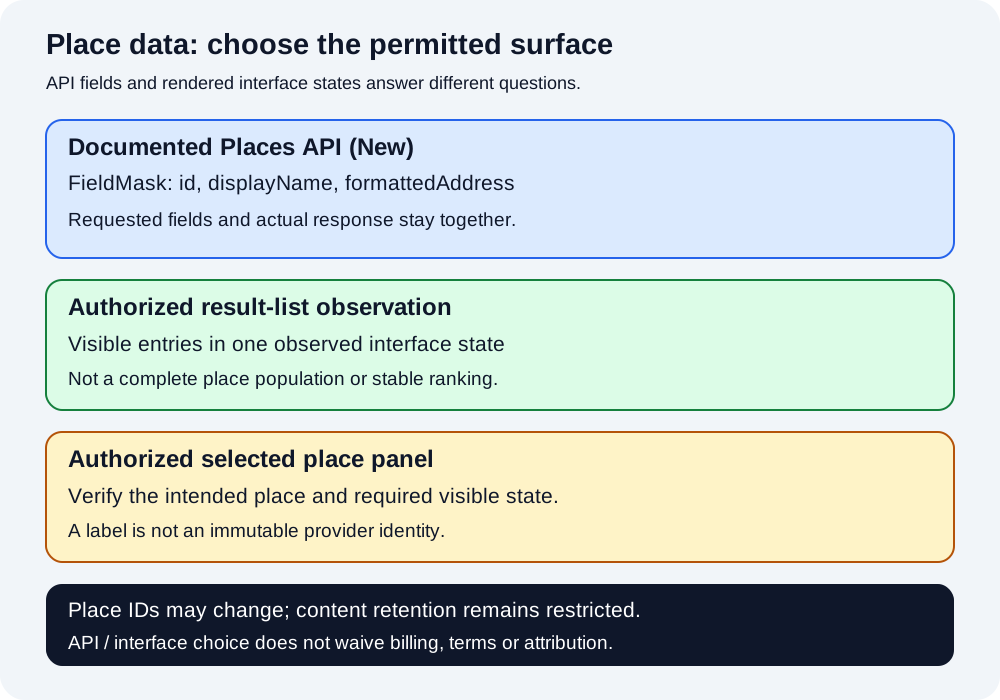
The Places API overview describes supported services for finding places and retrieving details. For a new integration, identify the documented API version and operation before selecting fields. A Place Details response concerns a selected place reference; a search response concerns the operation's search question. Do not combine examples from different API versions into a single assumed response contract. The supported operation, requested fields and actual returned representation belong together.
| Surface | Question it can answer | Boundary to preserve |
|---|---|---|
| Documented Places API | Which supported fields did this permitted operation return? | Requested fields, operation and applicable terms govern use |
| Authorized rendered result list | Which entries or labels were visible in this observed list state? | Visible entries are not a complete geographic population |
| Authorized selected place panel | What did this selected interface state display for the intended place? | Panel content is not a universal API schema or an access exception |
The rendered rows describe conditional observations, not a claim that the current Google Maps interface always exposes particular fields. No live Maps list or panel collection is claimed. An approved interface test may need to inspect a label, selected-place state or localized presentation. That is a different question from obtaining a supported business field through the API. State the interface question explicitly instead of treating every visible string as a substitute data service.
The shared observation pipeline separates acquisition from interpretation. Apply that separation without assuming the same retention permission for every provider. An internal representation should distinguish API-supplied data, permitted interface observations and downstream inferences. It should not erase the originating surface when fields are passed to another component. A field's meaning and allowed use do not become broader because an application stores it in a common table.
Source approval comes before the browser choice. If the documented operation cannot supply a required field under the applicable agreement, the outcome may be an unsupported requirement rather than a reason to inspect another interface. Review the supported integration and permitted use. Neither an accessible page nor a configured browser changes the terms attached to the content. Do not use the surface comparison as a path around a paid field, a quota or a prohibited collection purpose.
Define the required fields before requesting them
The Place Details reference states that Places API (New) has no default list of returned fields for this method. Omitting the field mask returns an error. A field mask is therefore part of the request contract, not an optional description added after collection. Record which fields the application requested when interpreting an absent response member. A field not requested has not been observed as empty, false or zero.
| Field group | Documented API field examples | Interpretation boundary |
|---|---|---|
| Place reference | id and name | Resource name is not the human-readable business label |
| Display and address | displayName and formattedAddress | Display text is not an immutable identity key |
| Operating state | businessStatus | A missing value is not a closure determination |
| Reputation summary | rating and userRatingCount | A summary is not a complete review collection |
| Opening information | regularOpeningHours | An absent field is not evidence of continuous opening |
The official field table associates fields with operations and billing categories. Do not assume that a field available through one method has the same category or behavior through another. Define the smallest supported set that answers the approved question, and check the current documentation for that method. No fixed price or unrestricted availability follows from the table above. The table identifies vocabulary and interpretation boundaries, not a billing estimate.
The distinction between name and displayName is concrete. The Place Details documentation defines name as a resource name in the form places/PLACE_ID. It identifies displayName as the field for the place's text name and lists it under a different billing category. Renaming the resource value to a business-name column would change its meaning. Parsing a visible label instead is also not permission to avoid the documented field's terms or cost.
Field presence and field meaning need separate checks. A rating summary does not establish that every review was returned. A formatted address is a provider-supplied representation, not proof that a business operates at every nearby result position. An opening-hours value should retain the meaning supplied by its field, rather than becoming a general promise about service availability. Where the requirement needs stronger evidence, return the limitation instead of manufacturing certainty from a familiar-looking label.
Keep place identity separate from display text
The Place IDs guide says that place IDs identify places in the Google Places database and on Google Maps. It also states that the same place can have multiple different place IDs and that IDs may change over time. Those limits matter when comparing observations. An identifier is more specific than a shared business name, but it is not a promise that one stored value will remain unchanged forever.
Use the actual provider reference with its source and observation context. Do not combine two businesses solely because their labels match, or declare a new business solely because one provider reference changed. A changed identifier creates a reconciliation question whose evidence must be examined. The provider's documented guidance, returned fields and approved use determine what can be established. Similar addresses or labels may help an investigation, but they do not independently prove the same legal business or location.
The guide recommends refreshing identifiers older than 12 months. That recommendation concerns identifier maintenance, not permission to keep every associated field for the same period. Keep the identifier-refresh decision separate from content retention and from the timing of a live business observation. Revalidating a reference does not establish that an older rating, address or opening-hours value is still current. Each accepted field needs the source and freshness meaning required by the application.
The job-posting identity comparison distinguishes a source record from a real-world entity. Place data needs the same distinction, with Google's own identifier guidance replacing job-board assumptions. A business brand can have multiple locations, while similar visible labels may refer to unrelated places. Preserve uncertainty when the approved evidence does not resolve the match. Do not silently merge records in a way that makes an identifier change appear to be a business opening or closure.
Apply storage and attribution rules to the chosen use
The Places API policies restrict prefetching, caching and storage beyond permitted exceptions. They separately exempt place IDs from caching restrictions. That exception is specific: it does not make the rest of a place response an unrestricted content archive. Before retaining field values or copies of responses, determine the agreement and exception that apply to that use. A provenance requirement cannot override a provider's content-storage restriction.
Where raw content cannot be retained, design operational records within the allowed scope rather than copying the response anyway. A request outcome, selected operation or permitted identifier may answer a diagnostic question without preserving every content field. Whether any particular record is permitted still depends on the applicable terms and data it contains. The engineering requirement is to make that decision explicit. It is not to rename a content cache as a log and assume the restriction disappeared.
The same policy reference covers map display, Google attribution and third-party attribution. It describes requirements for displaying Places results on a map and for displaying them without a map. Photos and reviews have additional author-attribution requirements. Do not assume that moving a field into a different interface removes those obligations. A technically successful response and a correctly attributed permitted display are separate acceptance questions.
Applicable terms can differ by billing region, including the documented European Economic Area distinction. Check the terms tied to the actual account and use rather than treating a general example as universal legal permission. The rendered Maps interface also does not inherit unrestricted reuse rights from the API comparison. If a use is not supported under the applicable terms, stop or choose an approved alternative source. Browser configuration is not the mechanism for changing that decision.
Limit rendered observations to interface questions
An authorized rendered test can answer a presentation question that a structured field does not represent: which label was visible, which place was selected, or whether the expected panel state had loaded. The observation is bounded by the actual state and permission for that test. It does not establish every place in a region, an exhaustive review set or a stable result order. Those would require different evidence and an applicable supported source, not simply a longer browser session.
The BotBrowser GeoIP documentation describes profile prerequisites and geographic lookup with proxy routing. These are browser-environment inputs. They do not define a Maps search location, establish where a business operates or guarantee how a service orders results. A test that needs a specific observed location must verify the relevant interface or documented operation separately. The intended browser environment and the service's actual response are different evidence.
The getting-started documentation covers profile-first startup, automation integration and verification. Use that documentation for the browser setup itself. A successfully launched browser does not prove that the intended place panel loaded or that its content can be collected for a different purpose. In an approved test, confirm the selected place and the required visible state before interpreting a label. Return an unresolved observation if that match cannot be established.
Keep browser failures in the browser layer. A timeout, incomplete panel or unexpected page is not a new value for the business field. Preserve the failure outcome separately from any last accepted observation, subject to retention rules. Changing browser identity, accounts or routes after a refusal is not a valid way to establish the missing field. If access or purpose is not permitted, the observation should stop rather than expand its scope.
Classify missing data before changing the collector
Missing data has several possible causes: a field was not requested, the selected operation does not support it, the response omitted it, or the intended interface state was never observed. These explanations require different actions. Start with the recorded operation and field request, then inspect the actual outcome within the allowed diagnostic scope. A missing userRatingCount is not a measured zero, and an absent businessStatus is not a closure statement.
MDN's Fetch documentation states that the fetch promise can resolve when response headers arrive even for an HTTP error status. Request completion is therefore weaker than a successful application response. Separate transport, HTTP status, supported representation and required-field acceptance. A parser returning an object cannot by itself prove that the requested place or field was established. Apply the operation's documented error interpretation rather than converting every failure into an empty place record.
For an approved interface test, distinguish an absent label from an unverified panel. If the intended place was not selected or the relevant state was incomplete, no business-field observation was established. If the field was visibly absent in a verified state, retain that narrower observation without inferring a global API limitation. No current Maps panel implementation is measured here. These are acceptance rules for a permitted test, not a claim about a protected service's behavior.
The Places field reference can resolve a vocabulary or operation mismatch; it cannot repair an unsupported use. The next action should match the evidence: correct the approved field request, handle the documented response, inspect an authorized interface state, or return the unsupported requirement. Do not switch surfaces merely to make a missing value look obtainable. Source choice, field interpretation and permission must remain consistent through the final dataset or display.
FAQ
Is the Places API the same as Google Maps scraping?
No. The API is a documented service with supported operations, field selection and applicable billing and content rules. A rendered list or panel is an interface observation with its own context and permissions. Neither surface makes the other an unrestricted alternative.
Does a missing field mean the business has no value for it?
Not necessarily. The field may not have been requested or supported, the response may omit it, or the intended state may not have been observed. Keep that uncertainty instead of converting missing information into zero, closure or continuous opening.
Can place IDs be treated as permanent business keys?
The official guide says IDs can change and the same place can have multiple IDs. Use source references with the documented maintenance guidance and preserve unresolved identity changes. A shared visible business name does not settle the match.
Does BotBrowser change Maps data access or API policies?
No. BotBrowser provides browser-environment inputs for authorized observations. It does not supply place content, waive billing, change storage or attribution terms, or guarantee result ordering and completeness.
Sources
- Places API overview
- Place Details (New)
- Place Data Fields (New)
- Place IDs
- Places API policies
- MDN Fetch API
- BotBrowser GeoIP database
- BotBrowser getting started
Practical conclusion
Choose the permitted place-data surface from the actual field or interface question. Keep operation, field selection and provider identity distinct from display text; interpret missing values before changing the collector. Apply the relevant storage and attribution rules to what is retained or displayed. Browser configuration supports an authorized interface observation, while the source and its documented terms determine what that observation can establish and how it can be used.
This article is part of the guide: Browser Deployment and Release: Operations Map
Related Articles
Scraping Indeed Jobs: Fields, Pagination and Duplicates
DeploymentHow to Scrape Amazon: Product Data and Browser Limits
DeploymentScraping Shopify: Storefront API, Ajax or Browser?
DeploymentZillow Scraping: Listing IDs, Prices and Status History
DeploymentJob Board Scraping: Browser Boundaries
DeploymentJob Posting Scraping: Titles, Reposts and Closure
Run the same check in BotBrowser
Load a profile, keep the signals you just read about consistent inside the browser, and confirm the result on your own machine before a rollout.